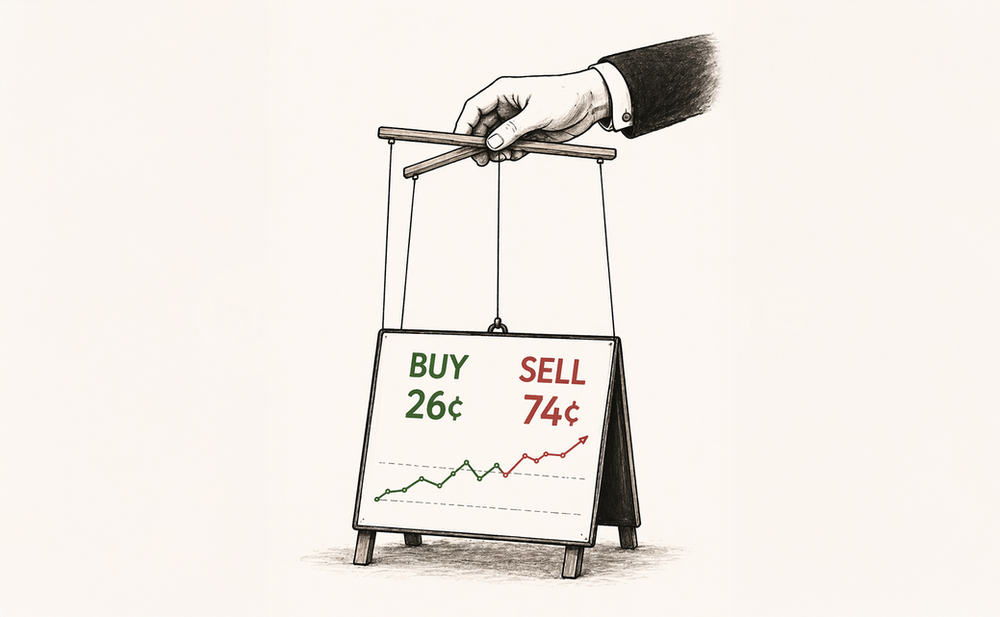
Someone wagered roughly $30,000 that Nicolás Maduro would be seized.
Hours later, it happened.
The payout? More than $300,000.
That’s not a prediction. That’s proximity to information. And it’s happening more often than anyone wants to admit.
Prediction markets, notably Kalshi and Polymarket, are exploding in popularity. They promise something elegant: the “wisdom of crowds,” a real-time pricing of the future. Will a war break out? Will a bill pass? Will a leader fall? Who will be the next Fed chief?
But beneath that elegant premise is a more uncomfortable reality: We’ve built a global marketplace where insider information can be monetized instantly. And in some cases, anonymously.
The Maduro trade is just one example. In recent months, there have been eerily well-timed bets on geopolitical events, including military activity, diplomatic moves, and regulatory decisions, where the traders weren’t just early. They were exact.
In traditional markets, we know what to call that: insider trading.
Try placing a $30,000 options trade on a stock minutes before an acquisition announcement, and the U.S. Securities and Exchange Commission will be knocking on your door. Trade on nonpublic information, and it’s not a gray area. It’s illegal.
Prediction markets? Not so simple.
It's because you’re not trading equities, you’re trading outcomes. Event contracts. And in the U.S., that puts them under the jurisdiction of the Commodity Futures Trading Commission, which is only now beginning to grapple with what insider trading looks like in this new context.
In early 2026, the CFTC’s enforcement division issued guidance tied to the misuse of nonpublic information in prediction markets, an early signal that regulators see the problem. Lawmakers are moving too, introducing bills like the DEATH BETS Act, BETS Off, and the Prediction Markets Security and Integrity Act to curb the most extreme use cases and limit who can participate.
But the core issue runs deeper than legislation. Because this isn’t just about trading. It’s about communication.
Every insider trade starts somewhere: a text, a forwarded email, a side conversation that wasn’t supposed to travel. A fragment of nonpublic information leaks into the wild and suddenly, someone is placing a “prediction” that looks a lot like certainty.
That’s the blind spot.
Markets are being monitored. Trades are being analyzed. But the source of risk, the communication that carries sensitive, nonpublic information, is largely invisible.
This is where the problem and the opportunity come into focus.
At Alphy, we’ve spent the last several years building HarmCheck to detect exactly this kind of risk: language that signals the presence of material nonpublic information, unfair advantage, or conduct that could trigger regulatory scrutiny. Not after the trade. Not during an investigation. But at the moment the communication happens.
Because by the time a $30,000 bet turns into $300,000, it’s already too late.
The future of compliance won’t be built solely on surveillance of transactions. It will be built on understanding the intent, context, and risk embedded in human communication before it becomes action.
Prediction markets are forcing a new question into the open: If someone knows the future, should they be allowed to profit from it? And just as importantly: Can we detect the moment that knowledge changes hands?